Monday Project Report – Socks, Socks and More Socks!

One of my dreams is to one day have a sock drawer full of handmade socks.  I was reading Glenna C.’s blog one day and she wrote about how cool it was to open her sock drawer and see all handmade socks.  That just sounded so cool that I decided I wanted that too.

That, of course, meant that I had to learn how to knit socks.

Which also meant that I had to learn how to make socks for Chip since if I was going to goof up on socks, I didn’t want it to be on mine.  (grin).

I have previously blogged about my first pair of socks, that I made for Chip.  What I may not have mentioned is that not too long ago we discovered that our puppy Tucker decided to express his undying devotion for Chip by eating everything that really smelled of him – which of course meant he had to eat every wool sock Chip owned – INCLUDING the pair I knit him.  Sigh.

Which is what spurred me to make Chip his second (and now only) pair of handknit socks using the Knitty.com Thuja pattern.  They turned out pretty good.

Chip's Thuja Socks

The thing I like about this pattern is one, it uses dk weight yarn rather than fingering weight so it knits up faster, and two, it uses a size 6 needle so it is finished even faster!  I made these socks in about 10 days – which is like speed racing in my world of sock knitting.  That part made me happy!!

top view of Chip's Thuja sock

Problems – the pattern states you should use worsted weight yarn but the gauge is a dk weight gauge so I went with a dk weight yarn – Regia’s Design Line Kaffe Fassett 6 ply which is also a washable sock yarn – and it worked out well.  I also did not like the slip stitch the pattern calls for in the heel turn because it resulted in noticeable holes that I later had to weave yarn into to fill.

heel of Thuja sock

However, as a quick knit sock, this one will do the trick and you can use varigated yarns too because there is no pattern you are going to hide.  Easy.

Toe of Thuja sock

So then onto MY first pair of hand-knit socks.  I showed you previously the beginning of my Moody Stockings which were designed by Erica Lueder – who is currently my favorite sock designer.  Here is what they looked like completed – well – what one looked like completed.  I made two, however Markus was doing the sock modeling that day and he just wasn’t feeling it, you know?  So he only modeled one sock. :D

The Moody Stocking

The other one looks just like it.

side view moody stocking

I like how the heel turned out.

moody stocking heel

It was also my first time using a kitchener grafting stitch.

moody stocking toe kitchener stitch

It came out okay, but I am not sure I like how the kitchener stitch forms two points on the sides of your toes.  I will have to give this more thought.  Knitting these socks was made even more wonderful by the fact that I was knitting using Sanguine Gryphon’s Little Traveller yarn in the Rojas colorway.  Absolutely wonderful yarn in a stunning deep red.  They are just great yarn dyers.

THEN we get to the socks I am working on now.

First, the Ravelry Sock Knitters Anonymous group sucked me in on another mystery sock KAL (the Moody sock was their November mystery sock) so I have started the Sock Strap sock, designed by General Hogbuffer which is their mystery sock for March.  I am using my Noro yarn (to use it up – I HATE the lack of quality of the Noro base yarns which no quality of dyeing can cover up) so I am only knitting one sock at a time in the hope I will be able to later find a repeat of the colors used in the first sock for the second.  I think my chances of making matching socks is little to none. :P

Mystery socks are divided into four parts with each part provided weekly.  The first clue had me knit the center back panel of the sock through the heel turn.

clue one of sock strap sock

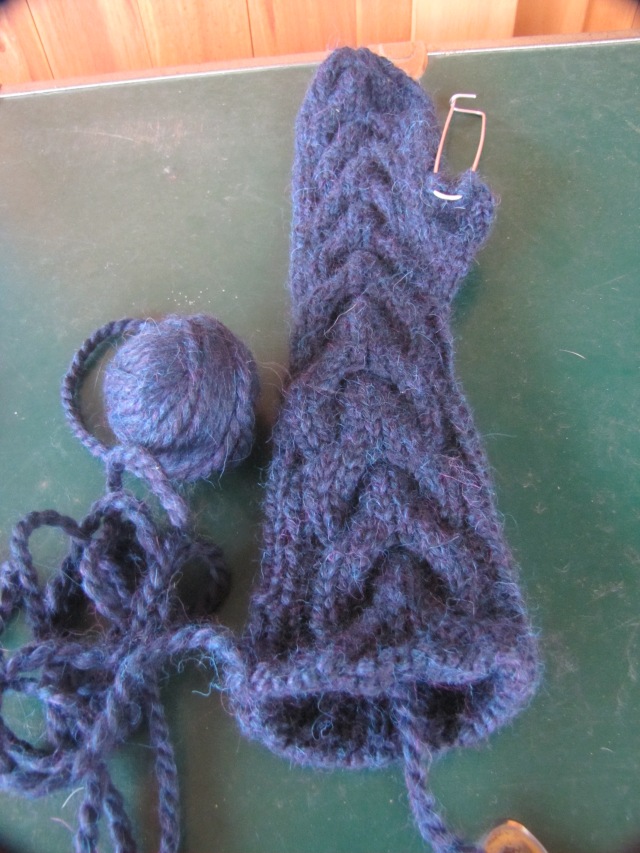
The second clue is the “strap”.  I had to pick up stitches all along both sides of the sock and around the base.

picking up stitches along the side

Then from these stitches I had to knit out from the back panel to make the strap.

sides of back panel added - clue 2

I am not loving this sock at all at this point.  First, though the designer recommended that we use a Noro yarn with gradual color changes, it did not work with the way we are directed to pick up stitches along one side using a long strand you save at the beginning of the sock.  By the time you are at the point that you are now working out the sides of the strap, the colors have changed drastically from what they were at the beginning – which is obvious from the one line of red that stands out like a sore thumb on one side of the panel that you will be able to see when worn.  Sigh.

Noro skein next to sock

Second, at this point this design feature is not looking all that attractive.  If you look at the outside of the Noro skein I bought, you can understand why I was not expecting to be knitting a teal and aqua sock.  And I would not have put that aqua against the purple/denim blue.  Sigh.

Third, the designer is not really clear on how to determine which size that is offered (of which there are 5 – from XS to XL) would be the correct size to knit for your size foot.  I am making the size small, figuring that if it doesn’t fit me, Jesse will LOVE this crazy color combination.  At least it should fit someone in this house.

But even this sock, knit on size 2 needles, is not my craziest sock endeavor yet.  My craziest sock project is the one I am starting this week.

KNEE SOCKS!!

Knit on size 1 needles with fingering weight yarn!!

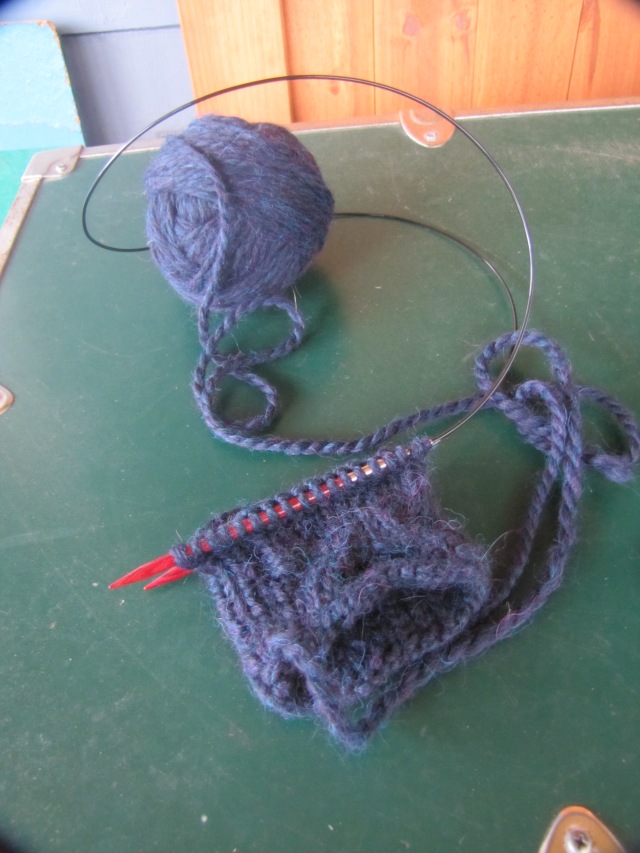
the beginning of my Counterpane knee socks

At least the yarn is Madelinetosh (collective sigh) in the “Ink” colorway and I am using the Dreamz circular needle in a 40″ length – magic loop method.  I love the Dreamz needles.  Beautiful wood, long narrow tips and not sticky when knitting with them.

But I still think it will be awhile before I am posting a project report telling you they are done.

Oh, and I did cast on a second Uhlan hat – this time for Vash using the Lorna’s Laces “Robot Overlord” yarn.  We couldn’t resist the name for Vash.  Here is just a quick look at how the colors are knitting up.

swatch of Robot Overlord

He’s quite happy about it.  :D

So that is all on what is happening with socks in our house.  I will leave you with a picture of the boys hanging out on their fort in the dog run during some of our March snow.  Hope your March is feeling more like spring than winter.

the boys in the fort in the dog run

Onward and Upward.

Posted in knitting, yarn | Tagged , , , , , , , , , , , , , | 4 Comments

Food on Friday – Bread-making 101

So here we are, back to my hippie cooking lessons from when I lived on the self-sufficient organic farm in my hippie youth. :)

Bread, I learned, requires only 3 ingredients- flour, water and yeast.  All the rest is extra.  The addition of oils and milk will give you a moister bread, eggs add richness and flavor, sunflower seeds will lend oil and crunch . . . you get what I mean.  Today I am going to share with you my favorite bread recipe – which goes a little beyond the flour, water and yeast version – and talk about how to make your own homemade bread.

The first thing to know about making bread is that temperature is very important.  Yeast is a living organism.  If your water or other liquids are too hot, you can kill the yeast.  If the mixture is too cold, it will put your yeast to sleep.  Ideally everything should be on the lukewarm to warm side of things.

That means if you are going to add eggs to your bread, you need to take them out of the refrigerator ahead of time so they can reach room temperature before adding them to the batter.  Same with your flour.  If you keep it in a cool pantry, bring it out and leave it in a warm kitchen overnight so it is at least room temperature in the morning.  Cold ingredients can lead to flat bread.

I like to add milk, butter and honey to my bread.  The milk, however, has to be scalded and then the butter and honey melted in the milk, so that all has to be done ahead of time to allow time for the whole mixture to cool to lukewarm before adding it to the yeast.  You don’t want to scald your yeast when you add the milk as that too can lead to flat bread.

To scald your milk, heat it just to the point that the oxygen starts to bubble out of the milk along the sides.

scalding milk

Then place your stick of butter in the hot milk to melt it, then stir in your honey.

adding honey and butter to the scalded milk

I use 3 cups of milk to one stick of butter and about 5 tablespoons of honey.  This amount will produce 3-4 loaves of bread. (If your bread is still dry, consider substituting oil for the butter).  When I think that the milk is getting to the right temperature (stick your clean finger all the way to the bottom to gauge the temperature) I start preparing the yeast.

I begin by putting the water into a bowl – again, about 3 cups of water – making sure the water is lukewarm to a little warmer.  (It cools quickly so I start it out a little warm when putting it into the bowl).  Then I add two packets (or tablespoons if you are working with bulk yeast) of yeast to the water.  Ideally you should use one packet or tablespoon of yeast per loaf of bread, but this amount works well for the amounts I will give you without making it rise so much that holes form inside the bread.

yeast in warm water

As I said, yeast is alive and when you put it in a nice warm wet environment it comes to life.  And like any new life, it comes out hungry so I always add a tablespoon of honey to the warm water and stir it all gently with a metal spoon until the yeast has dissolved.  Yeast also feeds off of wheat, so if you don’t want to add honey to your bread, add some flour so the yeast has something to feed off of.

adding honey to the yeast

Then I let it sit in a sunny window or a warm place for about 5-8 minutes to let the yeast wake up, have some honey and start to grow.  You want to see it puff up and start to expand in the water before you start.

happy growing yeast

This part is important because you need to know if your yeast is good.  I can’t tell you how many times I have made a batch of bread, only to watch is sit as a blob in the loaf pans, barely rising, and producing thick, hard loaves of sorta bread – sigh – because I did not know to feed the yeast and keep it warm during the process – or I killed it by adding milk that was too hot or flour that was too cold.

So once you have your yeast happy and growing, slowly add in the lukewarm milk/butter/honey mixture and gently stir it all together.

milk, honey, butter and yeast

Then it is time to start adding your flour.  I use about 14 cups of flour to make my 3-4 loaves of bread.  I add it two cups at a time to the liquid, stirring it in until it all seems to be moistened, then add two more cups – going until I just can’t stir in any more.  That is when you flip it out onto your floured bread board and start kneading the remaining flour in.

mixing in the flour into the bread dough muffins cauliflower soup bread bella 083

There comes a point when you are kneading in the remaining flour when you know you have enough and you shift your main focus to just kneading the dough.  I do this for 20 minutes as it is the kneading process which develops the gluten in the bread.  Gluten, for those who don’t know, is the protein portion of the wheat berry and is responsible for the elasticity in your finished bread.  You will still be adding small amounts of flour to the bread board, and thereby to your bread, but that’s okay.  What is important is to give the bread dough the time to develop – to work out the excess air and work in the elasticity.

kneading the dough

I will usually commandeer a child (or husband) while I am kneading the dough to wash out the bread bowl that I made the bread in so that I can then oil it and put my bread dough in it for the first rising.  Basically cover the bottom and sides of your bowl with oil – put your bread dough in the bowl, turn your dough over, so that the oil covered bottom is now on top, cover your bread bowl with a towel and leave it somewhere warm (again – not hot) to rise until it is doubled in size.  It usually takes 1-2 hours, depending on how active your yeast is.  If you have a drafty house (like mine) you can put it in your oven.  I will sometimes warm the oven just a little before I put the dough in just to make sure it stays warm but not hot.

Sorry – I forgot to take pictures of this.  Sometimes I just get on a roll and forget that I am blogging this.  Basically, after 20 minutes of non-stop kneading I am so happy to have it in the bowl rising and to sit down that my mind takes a quick little nap – or shifts to the next recipe I am working on that day.

When you think the bread dough is double its size, butter your loaf pans.

buttered loaf pan

If you make bread alot you will be able to rationalize spending money on things like Fiestaware loaf pans.  I got one in orange and one in yellow for myself a few Christmases ago.  They make me happy – even if they are a little small.

Once the dough has risen to double in size, you punch down the dough – which is just like it sounds.  Take your fist and punch it down right through the center of your dough – the entire pile of dough will deflate.  It only takes one punch.

Then take the dough out of the bowl, put it on your bread board, divide it into the number of loaves you plan to bake and form your loaves.  I take each piece of dough, pull it roughly into a rectangular shape, then I roll it into my “loaf” which I then place in the loaf pan.

rectangle of bread dough

rolling bread dough

rolled bread dough

bread dough in loaf pansThis time I only made two loaves.  You will see why this was a mistake later – I should have made 4 loaves from this batch.  Anyway, after the dough is in the loaf pans, again grab your dish towel,cover your dough and let them rise in a warm place until they look like loaves of bread.

bread dough going into rise for the second time

bread dough after rising  risen bread

This takes about 30 minutes – maybe a little more.  If you have soft butter, you can gently rub some of the butter on the top of your loaves.

buttered top bread

Then bake them at 350 º for an hour and they should be done.  Always preheat your oven before putting them it.  It really does matter.

bread out of the oven

When they are finished, they should just fall out of your pan.  Cool them on a rack.

bread out of the loaf pan

This is how they look when cut.

sliced bread

Kinda spectacular, don’t you think?  My family thinks so.  They don’t even mind when it turns out all overgrown on top like this batch did.  See, that is why I should have divided this into 4 loaves instead of two.  Sigh.

So that is how we make bread in our house.

You can always experiment with this recipe – adding eggs, sesame seeds, ground oats, other types of flours – anything you want.  You can leave out the milk, butter and honey and make a peasant bread.  (Add more water though).  Dress it up or down, there is nothing like warm homemade bread.  Love it.

Hope you do too.

Have a great weekend all.

Posted in baking, cooking, recipes | Tagged , , , , , , , , , , | 8 Comments

Monday Project Report – Uhlan Hat

I know, I have not posted in a couple of weeks.  The good news is that usually means that I have work that actually pays me and I am busy supporting my family.  And I was busy for a couple of weeks . . . and then the boys had the week off from school. .  . and we had a storm or two . . . but now things are finally getting back to a place of calm so the blog is up and running again.  Yaaaaaaaaaaaay!!!

Yes, I did miss you all.

In the meantime, I was able to get a few projects finished – and the one I am most excited to tell you about is the Uhlan Hat!!

Markus wearing his Uhlan hat

This is a free pattern on Knitty.com designed – well, interpreted – by Franklin Habit.  There are alot of things to love about this pattern.

face shot markus in Uhlan hat

For one – it is REALLY warm.  It covers the head, the ears and the neck and, for an active boy living in the Northeast part of the U.S., that is essential.

back of Uhlan hat

The ribbing around the face can be folded back so you can see easily . . .

Uhlan hat with ribbing folded back

or kept in a tube to reduce the impact of winds on the face.

Uhlan hat with ribbing tube

It is also fairly easy to knit.  You start by knitting a rectangle which is at the top of the head and then you pick up stitches along two sides to knit the main body of the hat.

Uhlan hat crown

Uhlan hat side of crown

When you get to the end of the hat portion, you just cast stitches to connect the sides around the face opening and start knitting the k2 p2 ribbing down the neck.  When you have completed the neck portion, you pick up the stitches surrounding the face opening, knit a k2 p2 ribbing around the face for 2 inches – and it is done!!  (If you don’t want the “tube” option you can just knit a one inch ribbing and be done with it.)

Uhlan hat

The yarn was really nice to work with.  This is Mission Falls 1824 superwash wool.  Though the skeins are only 50 grams – only 85 yards per skein – I got it on sale at my local yarn store at her February sale and it only took 3 skeins for the entire hat.  The color is great – a darker orange so Markus could have a hat in his favorite color that would not be the neon orange that say, oh, the Storm costume was.

So, lets get to my favorite part of the hat.  It is . . . . .

POLISH!!!

Or at least Franklin Habit thinks it could be.  In researching the hat he found that “[t]he Uhlans were a lance-bearing Polish light cavalry, founded in the 18th century.”  And it is an Uhlan hat . . . . . .

He notes that the hat could be Prussian, or British, and that he could not actually find a picture of an Uhlan hat to prove any of this – but this was close enough for me!!  Made me happy to think of my boy wearing a good Polish hat to keep him warm – since it gets cold in Poland too!!

Okay, maybe I am stretching it just a little – but it made me happy while I was knitting it.  I love passing my love for all things Polish to my boys.

I have some more projects finished to show you soon – including TWO pairs of socks!!  Woo Hoo!!  I am also working on another pair of mittens (green – for Vash), finishing a vest, and a hat for the Xmas box.

Its been busy.

I will leave you with a picture of my two baby boys sitting in the snow together.

Gandalf and Tucker

Onward and Upward.

Posted in knitting, Uncategorized | Tagged , , , , , , , , , , | 6 Comments

Monday Project Report – The Beginning Of A Bulky Scrappy Blanket

For this week’s scrap project I turned to my bag of leftover bulky yarns.  After so much time pressured work to finish Xmas presents during the past two months, I was ready for some mindless knitting.  So I decided to make the Sediment Scraps Blanket by Katie Rose Pryal.  It is a garter stitch blanket knit on the diagonal and I have a feeling that she was not the first person to write down the pattern for such a thing (since my Mom makes dishcloths the same way), but hers was the one I found right away and she gets the credit from me.  This is a finished blanket which she posted on the pattern’s Ravelry page which shows what it can look like.  She recommends combining multiple strands of yarn to knit it.  I am just using my solid bulky yarns – I have other plans for the other weights of yarn I have. :)

sediments scrap blanket from pattern page

Basically you just start with one stitch.  Knit into the front and back (kfb) of that stitch to make two stitches.  Then every row thereafter you knit into the front and back of the first stitch of the row – increasing each row by one stitch.  It is just back and forth garter stitch.  When one side is the width you want, you elongate the blanket by increasing a row of the blanket by one stitch -  knitting into the front and back of the first stitch of that row – and then decreasing the next row by one stitch – by doing a knit two together (k2tog) at the beginning of the second row – alternating those rows until your blanket is long enough.  Then, of course, when you get it long enough, just knit two together at the beginning of each row until you get back to your one stitch.

angled photo scrap blanket

Mindless.  Easy.  Fast because it is bulk weight yarn.  Just what I needed so I could relax and just knit.

My bulky scrap yarn blanket

In the end I will have a blanket that reminds me of past projects.  Right now I can see, from the pointed end up, a sweater made for a little girl named Aurora, one Bella Mitten, Jesse’s hat, Jacob’s hat, Vash’s hat, a scarf for Chip (that he doesn’t use but the boys do), Jesse’s hat again and the other Bella Mitten.  There are also some short pieces from a couple of other scarfs near the end that are not really noticeable.

And then my bulky weight scrap yarn bag was empty.

I could have started working on a worsted weight scrap yarn project but instead I decided that I wanted to get a jump start on my next project – the socks that I started in November and then had to promptly put down in order to get the holiday knitting done in time. I am knitting the Moody Stockings which I will tell you more about when they are done.  For now, I will show you where they are at – well, as of yesterday when I took the photos.

I am using Sanguine Gryphon’s Little Traveler Yarn in the Rojas colorway for these socks.  I am also knitting both of the socks at the same time, working off of both ends of the yarn – hence why I kept the skein in a loose hank.

Sanguine Gryphon's Little Traveler in Rojas

This is a contrast and compare project in that I am knitting one sock using the 2 circular needle method and I am knitting the other using double pointed needles.  Right now I am not loving the two circular needle method but I think that is because my circulars are not long enough.  I think it would be much easier and faster if I had at least a 16″ length circular – or even a 24″ circular – so I won’t give up on the method quite yet but for this project, the double pointed needles are knitting faster and easier.

socks on two different types of needles

I wanted to do this pattern because I like textured socks.  I don’t really like lacy socks – holes in socks seems counterintuitive to me.  Cables can be too bulky to wear.  Textured socks have visual interest while still being comfortable.

moody socks showing texture

And I need a pair of red socks.  This is a great red.

So that’s today’s project report.  Hopefully I will be able to show you at least one completed sock by next week – if not two.  If I can finish a pair of socks in two weeks I will not only be doing the happy dance – I will be AWESOME!!

Just sayin. . . . .

Onward and Upward

Posted in knitting, yarn | Tagged , , , , , , , , , , , , | 10 Comments

Food on Friday – Stone Soup – Split Pea Style

I am an old hippie – and while a lot of my cooking and baking skills were learned from my Grandmother and Mother, my most basic and useful skills were learned while living on a self-sufficient farm in the Black Hills of South Dakota with three other families.  There we did not use “recipes” per se.  Our meals were centered around whatever food was available at that time of year or what was in the root cellar.  It was there that my true ability to “pantry cook” was developed – where I learned the basics of each type of food from which we build.

Many of us in my generation grew up reading a book called “Stone Soup” – which described how a wonderful, filling soup was created by everyone in a community just contributing whatever ingredient they had to a pot of boiling water.  That is – in essence – how every soup I make is created.

So lets talk about the basic way I make a soup – split pea style.

This week I had bought split peas because I was craving some thick warm split pea soup and I had not had any in a long time.  Split pea soup in recipes and in restaurants tend to be limited in their ingredients and I wanted a heartier soup.

The first thing I do when I am starting to make a soup is to go to the refrigerator and the pantry and start pulling out anything that I have that could go into it.

ingredients for split pea soup

Today it was onions, carrots, pepper, celery, kale, sweet potato and garlic.  While that would be enough to make it a great vegetarian soup, this time I decided to also add kielbasa to it – “Polish” it up a little.  While ham is traditionally added to split pea soup, a smoked sausage will work just as well.  Just make sure it is fully cooked before you add it to the soup.

For soup I chop the vegetables chunk size so they fit on the spoon better.  I cover the bottom of the soup pot with oil . . .
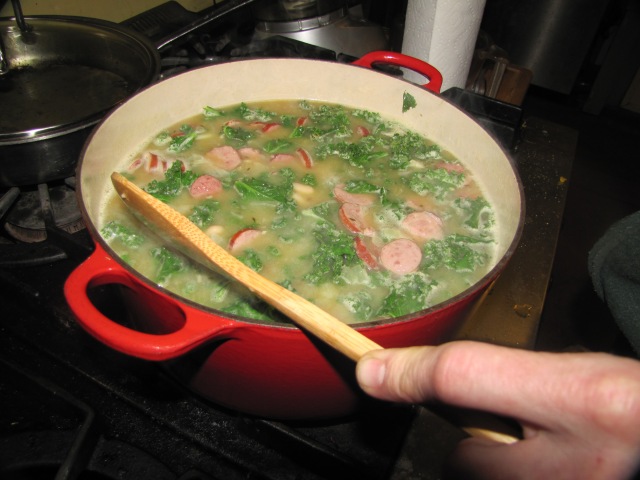
soup pot

and I start with the chopped onions.

chopped onions

While they are sauteeing, I chop my carrots and add them . . .

chopped carrots

always going from the vegys which take the longest to cook to those which take less time.  Next I add the chopped celery and pepper. . .

chopped celery and peppers in the soup pot

followed by the sweet potato and garlic.  (I fully believe that celery was created for soups – and for cream cheese sprinkled with paprika.)

raw vegys for split pea soup

Continue to saute the vegetables until they are all starting to get soft.  They don’t have to be fully cooked as they will have time simmering in the soup as we go along.

When I feel like the potatoes are starting to soften, I add the kielbasa – again chopped into chunks.  This is an easy step to skip to make a great vegetarian soup.

kielbasa in the split pea soup

Next I rinse my split peas in a mesh strainer . . .

split peas in a mesh strainer

and I add them to the pot.  I don’t add the water yet.  I let my grains saute a bit too while I am putting in the spices.

split peas added to the pot

Aren’t the colors just amazing?!!

You will notice that my soup pot is about half full of vegetables and meat.  These will cook down but I still want to know that my finished soup will have a lot of food in each spoonful, so I start off with a lot of good ingredients.  You can be creative here.  Depending on what type of soup you are making, there are lots of options.  Frozen vegys that have been in the freezer too long, or those canned green beans that you were saving for the zombie apocalypse that never came can be added about 10 minutes before your soup is done.  Canned organic beans are almost always included in soups and I pick them up whenever I see them on sale.  Buy all different types of beans – you never know what you might want to try in a soup.  (I would cook them from dry beans but I kind of have a reputation for “burning the beans again” so . . . . .) Canned diced tomatoes are good to have on hand too.  Also, noodles, rice, pastas, potatoes  – anything that could make your soup more filling – are all good to have when putting together a soup.

For the spices, again I just look at my spice rack and pull down what looks like it will go with what I am making.  For this soup I added a couple of bay leaves, some thyme (I love thyme in my soups – rarely is it not included), some crushed rosemary, salt and I added some ground mustard since I was using kielbasa as my meat addition.

spices for split pea soup

I rub in the spices, give it a stir, leave it on the heat for about a minute and then I add my fluid. I add at least 8 cups of fluid to start because I have to feed a large family and my amounts are based on that.

split pea soup after adding broth and spices

This time I had extra chicken broth at home so that was my fluid.  You could just add water and the flavors would work into it – or you could do what I do a lot, which is keep a few vegetable bouillon cubes on hand to create a quick vegetable broth for extra flavor.  There is a whole method for making and keeping great vegetable stocks, but if you are like me and don’t have the refrigerator room to store them, then this is a cheater’s way to get some of that flavor in your soups.

Then you let it cook at a simmer.  I cover it because I don’t want all the fluid to cook out of it – I want the flavors to go into the broth and stay there.  With split pea soup I know it will take anywhere from an hour to two hours for it to really cook to the point that the peas have broken down into that thick consistency that I love.  Keep watching it and stirring periodically as you don’t want your vegys to settle and burn on the bottom (charred split pea soup – not so good).  You also want to watch your fluid and add more water or broth as the splits soak it up.

split pea soup - almost finished

If you are going to add frozen or canned vegys, add them about 10 – 15 minutes before you want your soup finished.  I like to add kale and swiss chard to my soups so I will cut the leaves off of the spine, chop them coarsely and add them to the soup about 5 minutes before it is finished.  I added kale to this soup.  Kale and kielbasa – great combination – for future reference.

split pea soup

I made some homemade bread to go with this soup and the soup and bread made for a great – and filling – meal.

soup and bread on the table

The family loved it – especially Christopher.

So the basics for stone soup are:

- start with sauteeing your fresh vegys

- add your pre-cooked meat to the pot if you are using that

- add your spices – stir them through for about a minute

-  then add your fluid

- about 10-15 minutes before finishing your soup, add your pre-cooked additions that are not necessary to develop the flavors (like your pasta, rice, canned vegys., etc.)

- add your greens about 5 minutes before finishing the soup

- also consider if you want to sprinkle cheese on the top of the soup at the table and let it melt.

Obviously there are alterations and additions made if you are making a cream soup or a thin broth soup – but the basic ideas are the same.  Recipes are great – I just want you to feel free to alter them to make the soup one you will love.  Its kind of how us old hippies do it. :D

Next week I will tell you how we bake bread.

Onward and upward.


Posted in cooking, recipes | Tagged , , , , , , , , , | 2 Comments

Monday Project Report – Bella Mittens & Toothless Hat

I discovered two things this week.

First – I LOVE Misti Alpaca Chunky yarn.  It is soft – it is warm – and it is really so pretty knit up.

Second – I have to have a pair of Bella Mittens for myself.

Lets start with a very cute picture of Jesse.

Jesse on the porch wearing the Bella Mittens

Who is modeling my finished pair of Bella Mittens.

close up of Jesse wearing Bella Mittens

This is a long mitten . . .

full length Bella Mitten

which decreases 10 stitches in circumference from the opening to the wrist so it is fitted to the arm.

prayer hands bella mitten

The pattern on top is an easy C6F C6B every 8 rows with a purl stitch running along each side.

criss crossed bella mittens

The underarm side is a k1 p1 rib along the arm and a stockinette palm.

underarm side of bella mittens

This pattern is free on Ravelry (you can find it here) and is understandably very popular.  It is simple and – when knit in the Misti Alpaca yarn – instantly warm and soft.

Jesse holding mittens to face

Love this combination.

On the negative, this pattern is not designed for a large hand.  It fits my boys and me and is really a women’s small – though I think it would fit a women’s medium but it will be a snug fit.  If making it to fit a larger hand, then adjustments have to be made to the front and back of the pattern to give it some extra width.  A lot of folks also found the cuff to be too long and started knitting the pattern on row 16 to shorten the cuff length.

Finally, for anyone who wanted to know how the Toothless Hat ended up, here it is – finally finished.

Toothless Hat

Sis, the box for Emmet should go out this week.  I hope it fits him.

That’s all for this week’s project report.  Next week is scrap week!!  That means I am going to sit down with the odds and ends I have left over in yarn from other projects, separate them by weight and try to get some scrap yarn projects started.  We need afghans and blankets so that is my first thought – though it is always good to have a fish hat or two lying around for birthday presents – or my boys.  I ordered some new 40″ circular needles from Jimmy Beans this week just to knit blankets so I hope they get here soon.  Waste not, want not, as Gram always said.

Onward and Upward – as I always say. :D

Posted in knitting, yarn | Tagged , , , , , , , , , | 5 Comments

Food On Friday – Swedish Nut Cake

Super Easy.  Super Quick.  Super Delicious.

You only need to have on hand a few things that are a little out of the ordinary in your pantry – crushed pineapple, cherries and cream cheese – and you can make a wonderfully moist cake that should wow both family and guests.

Here is the recipe from out of the Family Cookbook.  This recipe is really simple to follow.

Recipe for Swedish Nut Cake

First, take out a stick of butter and an 8 oz package of cream cheese to soften to room temperature.  I try to do it early in the day so I know it will be ready when I am ready to make the frosting.

butter and cream cheese

For the batter, I start by beating the two eggs in the batter bowl (one less bowl to wash later).  Then I add the can of crushed pineapple and sugar and whisk it all together.

pineapple, sugar and eggs

While I am doing the batter, Vash starts working on chopping the cherries.  You can use the red maraschino cherries if you want but Vash is not a fan of them, so we use the black sweet cherries.

black sweet cherries

Because of the time of year we were not able to get fresh cherries so we used the canned ones.  I expect that frozen thawed cherries would work just as well.

Vash chopping cherries

I chopped the walnuts while Vash worked on the cherries.

chopped walnuts

Back to the batter.  Next I add the vanilla, cherries and the walnuts to the batter – and then I add the flour and baking soda.

cake batter

I think that I get a better distribution of the cherries and walnuts throughout the cake if I add them before the flour instead of after, but I have no idea if that is true.  It doesn’t seem to affect the cake batter itself so you can add them before or after the flour – however it works for you.

Then I lightly spray a 13 x 9 x 2 glass baking dish with non-stick cooking spray (too much and the taste will affect your cake) and pour the batter in.

batter in baking dish

After baking for 35 minutes in a 350 degree oven, it is done.

baked swedish nut cake

Test it with a toothpick to make sure it comes out clean, but 35 minutes in my oven seems to work pretty consistently.

Then, after the cake has cooled, I make the frosting by beating the softened stick of butter and cream cheese in a bowl with an electric hand mixer until the butter and cream cheese are blended well.  Then I add in the powdered sugar – a cup at a time.  Though the recipe says 2 cups, I use at least a half cup to a cup more.  Taste it as you go (I know, twist your arm. . .).  I found that the frosting was still too cheesey at two cups but is perfection with another half cup or more.  I often add a dash of vanilla to the frosting as well.

When the cake is cool, frost it with your cream cheese frosting

frosted swedish nut cake

and get ready to serve it, because it will go fast.

swedish nut cake after finished

My family really enjoys this cake and it does not last long in the house.  (It’s one of those cakes that everytime you walk past it you will want to just cut a sliver off and pop it in your mouth).  It has the moistness of a carrot cake but the sweetness of a pineapple cake.

serving of swedish nut cake

Yum.

I hope you enjoy this one.

I’m not sure what we are doing next week.  I was thinking a Ricotta cake, but my diet keeps steering me toward a soup.  We will see who wins – the diet or the sweet tooth.  Have a wonderful weekend all!!

Onward and Upward.

Posted in baking, cooking, recipes | Tagged , , , , , , , , | 4 Comments